
Delegation means giving someone responsibility for an outcome and the authority to deliver it, while you retain oversight. To stop doing everything yourself, you need to develop their capability and change the habits that keep bringing work back to you.
That’s the uncomfortable part. Every time someone asks a question and you immediately supply the answer, you remove their opportunity to think it through. Every time you take a task back because “it’s quicker”, you reinforce the expectation that you’ll sort it out.
Then you wonder why nobody takes ownership.
For many small business owners, this is where the overwhelm comes from. You’re frustrated with a team you’ve trained to wait, and somehow you’re still the person expected to fix everything.
Why Doing Everything Yourself Holds Your Business Back
When every decision comes through you, the business can only move as fast as your availability allows. Customers wait for answers. Your team is ready to get things done, but you’re in another meeting.
I’ve seen this in coaching sessions: routine customer returns still needing senior approval, while management meetings get swallowed by small operational issues. The bigger priorities barely move.
Meanwhile, you struggle to prioritise strategy, developing your managers or finding the next opportunity for growth. You’ll get to it when things calm down. Except another quarter passes, and you’re still dealing with the same problems.
That dependency can spread. Managers copy what they’ve learned from you, becoming the person their own team must ask before acting. Now you have several bottlenecks across the business.
You finish the week bloody exhausted. Everyone is paid and the work is moving, yet the business is no better equipped to cope without you. Your personal life gets pushed aside again, and the people you love are left waiting.
This is part of the founder dependency I address through The Hamster Wheel Trap®. Without changing it, growth can simply give you more people, more questions and more work to carry.
Where Does Delegation Begin?
“I can do it faster myself.” You probably can, today. But if you keep choosing the quickest option, when does anybody else get the chance to become capable?
Letting go feels uncomfortable when your name, money and reputation are tied to the result. What if they get it wrong? Sometimes there’s another question underneath: if they can manage without me, where do I fit? After years of being needed, watching them stop asking can feel surprisingly unsettling.
Your starting point is being honest about what you’re holding onto and why. Is there a skill they genuinely need to learn, or have you become used to stepping in before they can think?
Give people practice, support and room to use their judgement. When they can cope without you, take some pride in that. You helped them get there.
What Tasks Should Business Owners Delegate?
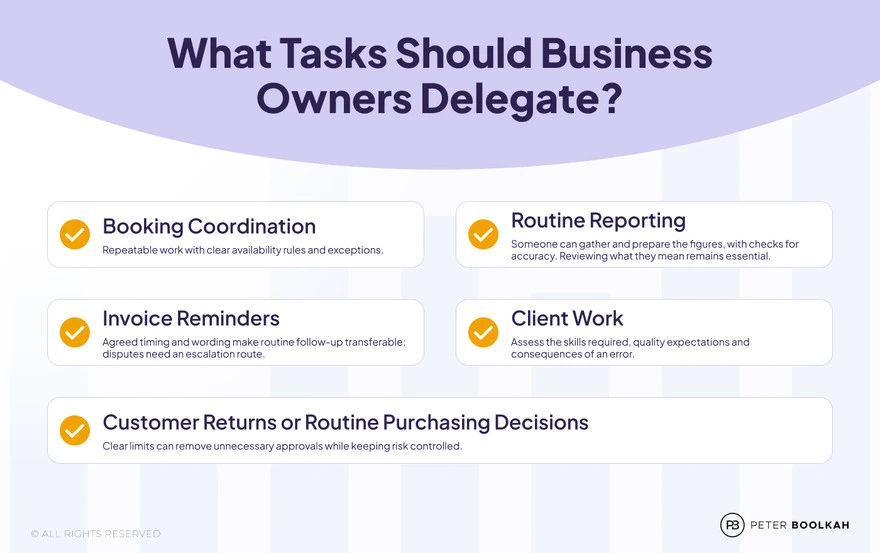
Start with recurring work that someone else could handle properly, such as booking coordination, routine reporting or invoice reminders. But don’t stop at the easy admin. Some client work and commercial decisions may also be ready to move beyond you.
Audit one normal working week, including the interruptions and “quick questions” missing from your to-do list. Record how often each task happens, how long it takes, what could go wrong and whether it genuinely needs your involvement.
Be honest here. Does the task need your expertise, or does it feel comfortable? Clearing familiar jobs can feel productive while the difficult conversation or decision sits untouched. A startup founder may initially need to cover everything; continuing that way as the business grows is a choice worth questioning.
Use a time management matrix to separate urgency from importance. That helps you see what needs attention, what needs protected time and what could be handed over or stopped altogether. Then assess who could take responsibility: an important task does not automatically belong to the founder.
| Example task | Suitable to delegate? | Why and what to consider |
|---|---|---|
| Booking coordination | Usually | Repeatable work with clear availability rules and exceptions. |
| Routine reporting | Usually | Someone can gather and prepare the figures, with checks for accuracy. Reviewing what they mean remains essential. |
| Invoice reminders | Usually | Agreed timing and wording make routine follow-up transferable; disputes need an escalation route. |
| Client work | Where capability allows | Assess the skills required, quality expectations and consequences of an error. |
| Customer returns or routine purchasing decisions | Within agreed authority | Clear limits can remove unnecessary approvals while keeping risk controlled. |
Choose one recurring responsibility that somebody else can realistically own. That gives you something concrete to change, instead of another week of hoping you’ll somehow get more done.
Should You Delegate Internally, Hire, Outsource or Automate?
If you’re running a small business, another salary is a serious commitment. Hiring just to make the pressure stop can leave you paying for help while still doing the work yourself.
Match the arrangement to the workload and budget. Compare the full cost, including training, supervision and your own time. Cheap support becomes expensive if it needs constant attention.
Delegate Internally or Hire for Regular Work
Before you recruit, check what your existing team is already carrying. Ask what needs to stop or move before adding responsibility. Piling more work onto someone already stretched can push them towards burnout. Your most reliable person shouldn’t have to sacrifice their evenings because you’re trying to reclaim yours. If the workload justifies a dedicated role, define the responsibilities, expected results and budget, and allow time for training.
Outsource Work That Needs Specialist Skills
You can run your own business without becoming an expert in everything it needs. Spending Sunday wrestling with a website problem has a cost, even if nobody sends you an invoice. For occasional specialist work, consider freelancers or agencies that specialise in that field. Agree the scope, fees, timing, expected result and ownership of the finished work. Explain what the business needs now; a long-standing supplier may still be working to an outdated brief. Check delivery against that agreement.
Automate Predictable Tasks
When every confirmation and reminder depends on you, even switching off becomes difficult. Automate predictable steps once the process is clear: booking confirmations, routine reminders and standard status updates. That can improve productivity and leave you more attention for running your business. Give someone responsibility for checking the system and handling exceptions. If a notification fails or a customer’s circumstances change, who notices and acts?
How to Choose the Right Person to Delegate To
Before handing work over, ask whether this person has the skills, confidence and time for this particular task. A job title or an enthusiastic “leave it with me” doesn’t answer that. Someone can be excellent with customers and still need help managing a budget.
They need clarity about what they will own, and you need an honest view of what they can currently do. Situational leadership helps you match support to the person and the task, rather than treating everyone the same.
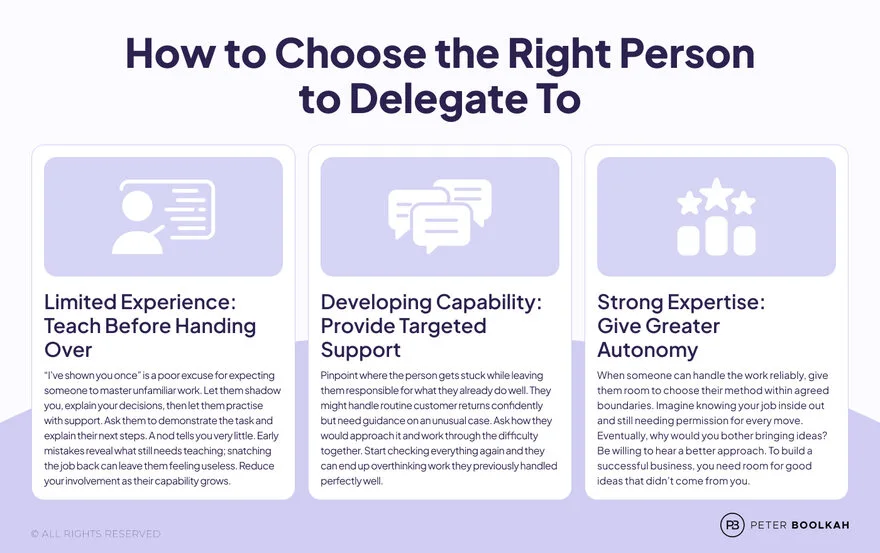
Limited Experience: Teach Before Handing Over
“I’ve shown you once” is a poor excuse for expecting someone to master unfamiliar work. Let them shadow you, explain your decisions, then let them practise with support. Ask them to demonstrate the task and explain their next steps. A nod tells you very little. Early mistakes reveal what still needs teaching; snatching the job back can leave them feeling useless. Reduce your involvement as their capability grows.
Developing Capability: Provide Targeted Support
Pinpoint where the person gets stuck while leaving them responsible for what they already do well. They might handle routine customer returns confidently but need guidance on an unusual case. Ask how they would approach it and work through the difficulty together. Start checking everything again and they can end up overthinking work they previously handled perfectly well.
Strong Expertise: Give Greater Autonomy
When someone can handle the work reliably, give them room to choose their method within agreed boundaries. Imagine knowing your job inside out and still needing permission for every move. Eventually, why would you bother bringing ideas? Be willing to hear a better approach. To build a successful business, you need room for good ideas that didn’t come from you.
How to Delegate Tasks Effectively
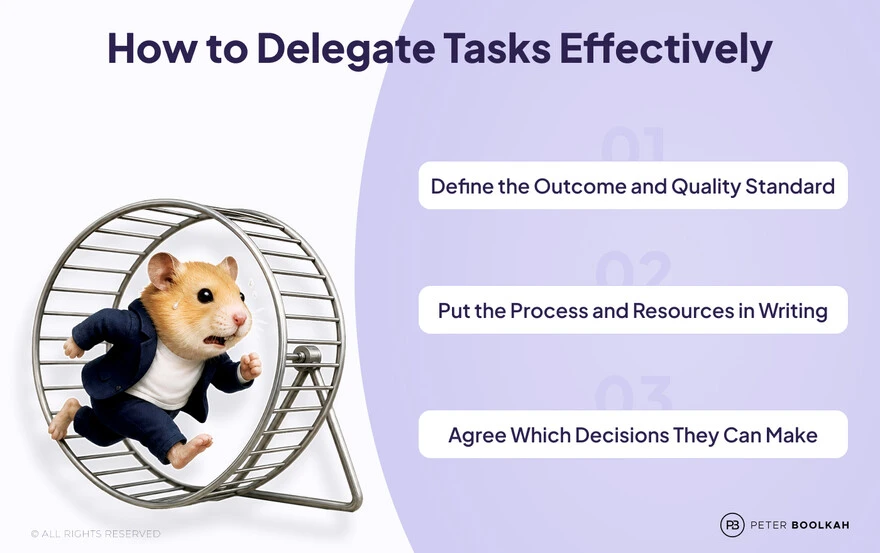
A proper handover covers the outcome, the resources and the decisions someone can make. Leave those unclear and your relief becomes their anxiety. Here’s how that works for a customer-service lead handling a return.
Define the Outcome and Quality Standard
“Sort the return out” leaves far too much in your head. Agree who owns it, the deadline and what an acceptable result looks like. For example: send the customer a decision under your returns policy by Friday at 3pm, explaining the remedy or reason for declining, and record it against the order. The response must be accurate, respectful and clear about what happens next. If your standard only becomes clear when you reject their work, don’t be surprised when they stop trusting their judgement.
Put the Process and Resources in Writing
Create a short checklist and, where useful, a recorded walkthrough. For our returns example, put the policy, exceptions and order-update steps in one accessible place. Give the person appropriate access to the records. A guide is useless if they still need you to unlock everything. Ask them to use it, flag gaps and keep it current. A page they actually follow beats a manual nobody opens.
Agree Which Decisions They Can Make
For our customer-service lead, you might allow refunds up to £250 when the return meets your policy. This is an illustrative limit; choose one that suits your business and their capability. Larger amounts, policy exceptions or compliance concerns go to a named manager, with cover for their absence. Then honour the agreement. Criticise a reasonable decision within those limits and you teach people that asking you first is the safest option.
How to Delegate Without Micromanaging
Agree when updates will happen, put those check-ins in the diary and keep them. If you ask “How’s it going?” every time you feel uneasy, your team can end up spending more energy reassuring you than doing the work. They’re watching your mood, wondering when you’ll step in. That’s exhausting for everybody.
Review progress, obstacles and decisions needing help. Make sure people raise serious problems before the next meeting. When somebody asks for an answer, try: “What do you recommend, and why?” Help them test their reasoning. Resist turning each check-in into another approval hurdle.
Follow through until the outcome is delivered. In our example, confirm that the customer received the decision and any promised action happened. Discuss what worked and add the key takeaways to the process. For recurring work, check that the improvement sticks over the following weeks. One good handover isn’t a lasting change if the job keeps landing back on your desk.
What to Do When Delegation Goes Wrong
You find the mistake and your stomach drops. A customer is waiting, the work isn’t right, and you’re already calculating how much of your evening it will take to fix. Deal with any immediate harm, but don’t let that become permanently taking the job back.
Find out what happened. Was the expectation unclear, access missing or a skill underdeveloped? Was something outside their control? Being unable to do the work and failing to do something they could reasonably have delivered need different responses.
Give specific feedback: “The customer was promised an update yesterday and hasn’t received one. What happened?” Listen, explain the impact, then agree who will put it right, by when and what support they need. A valid explanation still leaves a problem to resolve.
If the same failure keeps happening, change something. That might mean more training, fixing the process or reassigning the responsibility. Quietly correcting their work every time can feel easier than having the conversation. But it leaves them unaware of the problem and you increasingly resentful. Neither of you gets better that way.
Tools That Make Delegation Easier
If finding out whether a job is done means chasing three people through five message threads, the system is making you work too hard. Start with the tools you already have and agree how everyone will use them. Another subscription won’t resolve a conversation you’re avoiding.
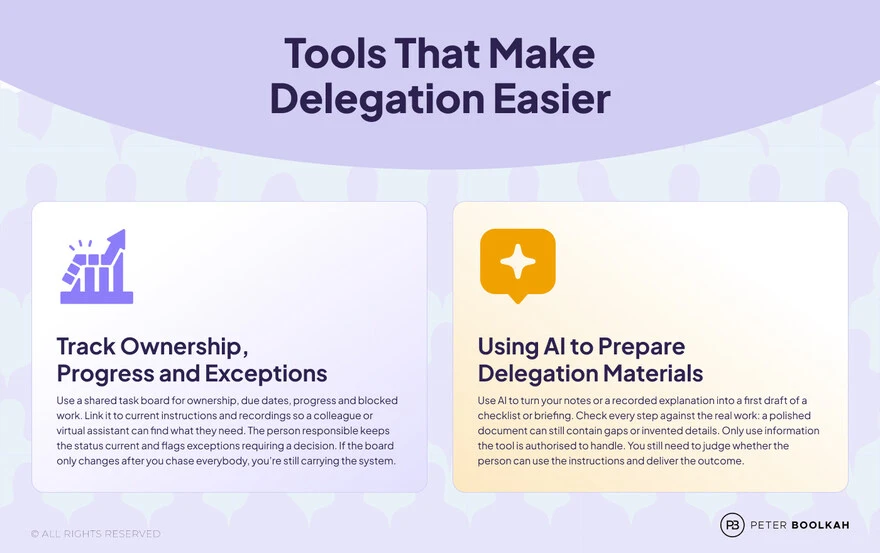
Track Ownership, Progress and Exceptions
Use a shared task board for ownership, due dates, progress and blocked work. Link it to current instructions and recordings so a colleague or virtual assistant can find what they need. The person responsible keeps the status current and flags exceptions requiring a decision. If the board only changes after you chase everybody, you’re still carrying the system.
Using AI to Prepare Delegation Materials
Use AI to turn your notes or a recorded explanation into a first draft of a checklist or briefing. Check every step against the real work: a polished document can still contain gaps or invented details. Only use information the tool is authorised to handle. You still need to judge whether the person can use the instructions and deliver the outcome.
What to Do With the Time You Get Back
An empty afternoon can make you feel guilty, as though you should be doing more. Resist filling it just to feel useful. Decide what the recovered time is for before routine work fills it again. Protect space to think about the business’s direction, develop your managers or explore an opportunity you keep postponing.
Protect some of it for your wellbeing, too. Take a proper break. Get home for dinner, put your phone away and actually listen to the people who have waited so long for your attention. You don’t have to turn every hour recovered into another hour worked.
Track the hours you recover and how often routine questions still pull you back. Try a planned morning away, with someone available for genuine exceptions. If work stops until you return, find out what still needs resolving. If it keeps moving, let yourself enjoy that progress.
Start Building a Business That Relies Less on You
You can love your business and still be sick of holding everything together. This week, choose one outcome somebody else could own and give them the support to deliver it. My business coaching helps you address the wider dependency as well as the habits keeping you trapped. You deserve to tell your family you’re taking time off and actually believe it yourself.
FAQs
How long does it take for delegation to save time?
There’s no fixed timetable. A familiar task handed to someone capable may save time quickly; teaching a new skill takes longer. Expect an upfront investment in training and checking. Keep taking the work back and you’ll still be doing it next year. Look for fewer routine questions, less rework and results delivered without you chasing.
How can you delegate without making your business dependent on one employee?
Keep one clear owner for each outcome, document the process and train someone else to cover it. Give both the necessary access and authority, then test the handover. If one employee’s holiday leaves you panicking, the dependency has simply changed desks. Build a team that can support each other.
How can I delegate work involving confidential information?
Give a capable person access only to what they need, through approved systems and their own account. Put confidentiality expectations in writing and check they understand what can be shared, with whom, and how to report a problem. Remove access when it’s no longer needed. Clear safeguards help you hand work over without lying awake wondering where customer information has ended up.
Can I delegate when I’m self-employed and don’t have a team?
Yes. Being self-employed doesn’t mean every bloody job has to be yours. A virtual assistant, bookkeeper or specialist contractor can take on a defined piece of work. Whether it’s your main business or a side hustle, start with one recurring task and a sustainable budget. Agree the outcome, provide what they need and check the result.
What is the difference between delegation and abdication?
Delegation gives someone an outcome, authority, support and agreed check-ins. Abdication dumps the work on them and disappears until something goes wrong. If they haven’t been trained or don’t know what good looks like, your frustration doesn’t make it their fault. Their responsibility for the work doesn’t remove yours for managing properly.
How can business partners agree on delegation when running a business together?
Agree who owns each area, what they can delegate and which decisions need both partners. Give the team that same clarity. If one partner hands over responsibility and the other keeps stepping in, people learn to wait or shop around for answers. Resolve disagreements privately and review the arrangement regularly. Otherwise, one partner feels undermined, the other feels shut out, and the team is stuck in the middle.

Since 2005, I’ve helped business owners scale profitable, valuable companies that can operate without depending on them.
A major focus of my work is founder dependency, what happens when the owner becomes the bottleneck and too much of the business relies on their decisions, knowledge or involvement.
I help founders break that dependency by strengthening leadership, systems, accountability, profit quality and predictable performance. The goal isn’t simply to build a bigger business. It’s to build a stronger, more transferable business that can continue to perform without you at the centre of everything.
That gives you something most business owners originally started their company to achieve: choice.
The choice to stay and grow it, step back from the day-to-day, or prepare the business for an eventual exit.
I’m also the author of Your Business Sucks: Build a Business That Works Without Destroying Your Life and was inducted into the coaching Hall of Fame in 2013.
- Delegation: How Business Owners Can Stop Doing Everything Themselves - October 20, 2026
- Insights Discovery: The 8 Personality Types - February 17, 2026
- Top 10 Best Sales Training Programs and Courses - October 22, 2025


